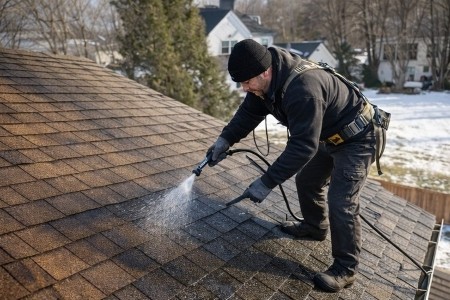
- Penetrates into aged shingles
- Bonds below the surface
- Restores flexibility
- Enhances moisture resistance
Rather than sitting on top like a coating, it becomes embedded within the shingle material itself.
If your roof is aging but still structurally sound, this is where roof rejuvenation can become a serious alternative to a full tear-off.
Performance Comparison: Refurbished vs. Brand-New Shingles
Performance testing comparisons show measurable differences between a typical new shingle and a treated 15-year-old roof system.
Impact Resistance (UL 2218)
- Typical new shingle: Class 2 (Pass)
- Treated roof: Class 3+ (Exceed)
In hail-prone Northeast Ohio, this distinction can be meaningful.
High Wind Resistance (ASTM D3161)
- Typical new shingle: 60 mph (Pass)
- Treated roof: 110 mph (Exceed)
Moisture Barrier Performance
- Typical new shingle: Pass
- Treated roof: Exceed
Hydrophobic Performance
- Typical new shingle: Not specified
- Treated roof: Exceed
Moss & Algae Resistance
- Typical new shingle: No
- Treated roof: Exceed
In additional categories such as fire resistance, UV resistance, tear strength, and wind uplift resistance, both systems meet ASTM standards.
Why Would a Treated Roof Exceed Certain Categories?
A new shingle leaves the factory with:
- Surface granules
- Asphalt binder
- Fiberglass reinforcement
But it does not include a below-surface bonding membrane system.
Treatment can:
- Improve granule adhesion
- Reduce algae and moss growth over time
- Enhance impact resistance
In simple terms, the asphalt matrix is strengthened internally, restoring performance characteristics that degrade with age.
Important Context for Solon Homeowners
This is not a shortcut for structurally failing roofs.
The treatment is applied to a roof system that originally achieved all code requirements at time of installation.
If decking is compromised, shingles are brittle beyond recovery, or chronic leaks exist, roof repairs or full roof replacement remains the appropriate solution.
This is a performance restoration system — not a structural rebuild.
When This Makes Sense in Solon
A 15-year-old roof in Solon may be a strong candidate if:
- The structure is sound
- There are no widespread active leaks
- Shingles retain structural integrity
- Aging is primarily flexibility and waterproofing related
In those cases, roof rejuvenation may:
- Extend service life
- Improve impact classification
- Improve wind resistance
- Enhance moisture protection
All without the disruption of a tear-off.
The Bigger Lesson: Measure Performance, Not Just Age
The takeaway isn’t that every older roof outperforms a new one.
Roof performance is defined by measurable standards — not just the number of years since installation.
Sometimes replacement is the correct move.
Sometimes refurbishment restores performance in ways that exceed certain factory baseline categories.
The only way to know is to evaluate the specific roof system and compare options side by side.
Compare Roof Options for Your Solon Home
If your roof in Solon is 10–20 years old and structurally sound, you may have more options than you think.
A fast way to get clarity is to start with a roof inspection, then compare repair, rejuvenation, and replacement side by side.
You can compare repair, refurbishment, and replacement — including performance standards — with instant roof pricing before making a decision.
Frequently Asked Questions About 15-Year-Old Roofs in Solon, Ohio
Is a 15-year-old roof too old to repair?
Not necessarily. If the roof structure is sound and the damage is localized, roof repairs may be enough to address leaks or problem areas without replacing the entire system.
How do I know whether I need roof replacement or rejuvenation?
If shingles are still intact and the roof is aging mainly through loss of flexibility or water resistance, roof rejuvenation may be a strong option. If the roof has widespread failure, recurring leaks, or structural problems, roof replacement is typically the better long-term solution.
What’s the best first step if I’m unsure?
Get a professional roof inspection. A proper inspection identifies whether problems are cosmetic, performance-related, or structural—so you can compare options confidently.
What if my roof was damaged by wind or hail?
If you suspect storm damage, it may be worth documenting the issue and exploring insurance claims and storm damage support to determine whether repair or restoration costs could be covered.